
Fannin Projected and Actual Release
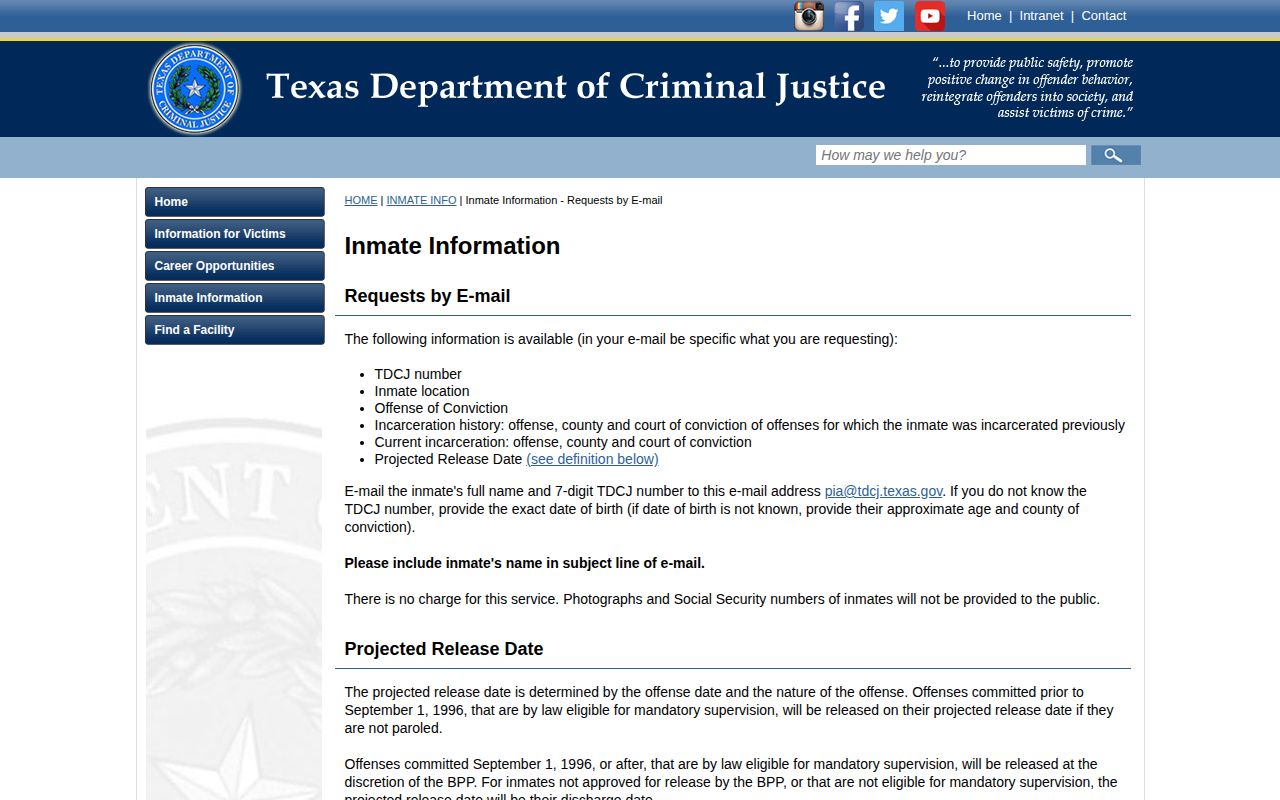
“Projected Release Date” is TDCJ's exact field label. It estimates when incarceration will end if parole does not occur first. The value can reflect the sentence, offense and offense date, credits, mandatory-supervision eligibility, and BPP action. It is not a record that the person walked out. An actual release record names the completed event and should distinguish parole, mandatory supervision, flat discharge, or transfer.
A pretrial detainee at Fannin County Jail has no sentence-based projected date. The court may authorize bond, dismiss a case, enter a commitment, or issue another order. The jail then processes that authority. A court date is not a jail-release appointment, and a bond amount is not proof that bond was posted. For a sentenced county prisoner, obtain the judgment, custody credit, commitment, jail calculation, and later discharge entry.
Find a Fannin Projected Release Date
First identify the custody authority. Buster Cole Unit and Choice Moore Unit are state prisons run by TDCJ. Fannin County Jail is a county facility that may hold local detainees as well as people controlled by another agency. A Bonham location alone does not tell which formula or record applies.
- Gather the full name, date of birth, and the best agency number: TDCJ number, SID, booking number, or court cause number.
- For a TDCJ prisoner, use the official offender search. Match the exact person, unit, offense, county and court before reading the Projected Release Date.
- If the state search is inconclusive, email pia@tdcj.texas.gov with the full name and TDCJ number. If unknown, provide date of birth or approximate age and county of conviction.
- For a Fannin County sentence, obtain the judgment and custody credit from the clerk, then ask the jail for its sentence calculation.
- After the date passes, request the actual release or discharge entry. Check whether the event was community release or transfer to another authority.
TDCJ also provides locator lines at 936-295-6371 and 800-535-0283 during its published weekday information hours. Exact date of birth is needed when no TDCJ or SID number is known. For a broader named-person search and county records path, use the Fannin County released-inmates page.
TDCJ's email information route can provide current location, offense of conviction, current and prior incarceration information, county and court of conviction, and the Projected Release Date. The service states that this information is supplied without charge. Request each field needed instead of asking a broad question such as “when are they out.” That wording helps the office return the displayed forecast while keeping it distinct from parole approval and a completed discharge.
Fannin TDCJ Good-Time Rules
Texas Government Code §498.003 establishes classifications and the earning of good-conduct time. Section 498.004 sharply limits what those credits do. They affect eligibility for parole or mandatory supervision, but they do not otherwise shorten the sentence imposed by the court. Credits may also be forfeited. A credit total therefore should not be treated as a fixed subtraction from the sentence or a promise of release.
Parole eligibility is offense- and date-specific under Government Code §508.145. For many serious offenses tied to Code of Criminal Procedure Article 42A.054, actual calendar time generally must equal one-half of the sentence or thirty years, whichever is less, subject to the statute's offense-specific minimums. Good time does not count toward that threshold. Other eligible cases generally reach eligibility when actual time plus good time equals one-fourth of the sentence or fifteen years, whichever is less, again subject to the governing subsections and offense date.
Eligibility is only the point at which release may be considered. It is not release. Mandatory-supervision rules and exclusions appear in §§508.147 and 508.149, and BPP may have a role in discretionary review. Read the current TDCJ result alongside the statute and the person's vote status rather than using a single arithmetic shortcut.
Why Fannin Release Dates Change
A projection changes when one of its inputs or legal assumptions changes. The effect may be an earlier date, a later date, or a different event type. Ask the record custodian to explain the current field rather than relying on an old screenshot.
| Factor | Possible effect | Record to check |
|---|---|---|
| Good-time forfeiture or classification change | Eligibility or displayed projection may move | TDCJ time and classification record |
| New sentence or corrected credit | Calculation changes | Signed judgment and TDCJ correction |
| Detainer or hold | Departure may become transfer, not community release | Holding and receiving agency records |
| Parole approval | Release may occur before the discharge estimate after processing | BPP vote, post-approval status, release record |
| Mandatory-supervision denial | Projected field may move to maximum or discharge date | BPP decision and current TDCJ result |
| Court order | Sentence or custody authority may change | Signed order and facility transaction |
A transfer is especially easy to misread in Fannin County because the county jail sits near two TDCJ prisons and has a documented history of contract populations. Leaving one building can mean entering another agency's custody. The destination and receiving-agency fields are essential.
When two sources disagree, note the time each was checked and the wording each used. A court order may authorize release before jail processing is complete. A county transfer entry may appear before TDCJ intake is visible. A favorable parole vote may precede required programming. These records can describe a sequence instead of a true conflict. Match the agency, event date, facility, and whether the value is projected or actual before deciding which fact each source proves.
No Fannin 85-Percent Rule
Texas has no blanket rule requiring every prisoner to serve 85 percent of a sentence. That shorthand should not be imported from federal discussions or another jurisdiction. Many serious Texas cases instead use the one-half-of-sentence or thirty-year actual-calendar threshold for parole eligibility. Other eligible cases may combine calendar time and good time under a different formula. The offense, offense date, sentence, and statutory subsection determine which rule applies.
This distinction matters when reading a TDCJ projection for someone convicted in Fannin County or housed at Cole or Choice Moore. Even a correct eligibility date does not command release. A BPP review can end in approval, denial with a next-review date, serve-all, or denial of mandatory supervision. A projected date can then move to the maximum-expiration or discharge date. The official Government Code Chapter 508 supplies the controlling framework.
For an eligible offense committed before September 1, 1996, TDCJ explains that a person eligible for mandatory supervision will be released on the projected date if not paroled. For eligible offenses on or after that date, mandatory-supervision release is discretionary with BPP. If BPP denies release, or the person is legally ineligible, the projected field can represent the discharge or maximum-expiration date. Later approval may prompt another calculation.
Fannin County Jail Date Calculations
Do not apply TDCJ's state-prison formula to a sentence served at Fannin County Jail. County calculations start with the judgment, sentence, commitment, and credited time. Texas law supplies general context for county good-time classifications in defined settings, but the research found no official Fannin-specific online policy for good time, weekend release, or release-day scheduling. The jail must provide the actual calculation.
Call Fannin County Jail at 903-640-4171 for immediate routing and ask whether staff can explain the sentence calculation or identify the right record custodian. For a durable answer, use the county's mandatory public-information form and request the booking/release entry, exact release time, release type, authority, and destination or receiving agency. The court record shows legal authority. The jail log shows when processing ended. Both may be needed to explain the event.
Read Fannin TDCJ Date Results
TDCJ results should be read as a set. Check the TDCJ number or SID, current location, offense, county and court of conviction, and Projected Release Date. A name alone is too weak when people share similar names. The search is strongest for current custody and supervision, not as a permanent archive of every person who has fully discharged. Absence does not prove release.
The TDCJ inmate-information page defines its projected-date field and provides the email route used when the public interface is inconclusive. The captured official page below supports that definition:
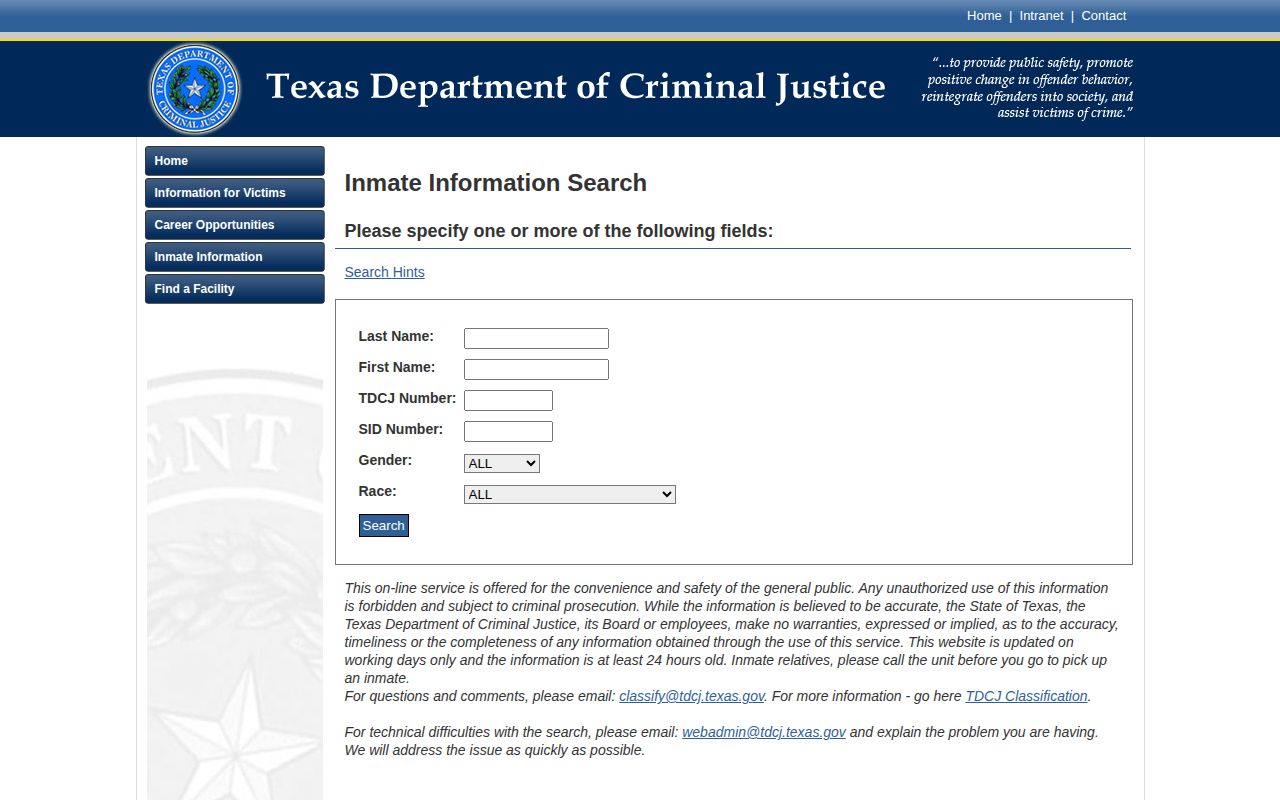
The official search start is also available as a direct source for a new lookup:
Open the TDCJ search form and use the strongest available identifier.
When a person was transferred from the county jail, allow for TDCJ intake and data processing. Keep the county transfer record so an initial state-search delay is not mistaken for release.
Confirm Fannin Actual Release Dates
Use a notification as a prompt to check the durable record. Texas moved county notifications from VINE to IVSS-Counties in 2025. IVSS may report a custody event quickly, but “release” does not rule out transfer. Save the alert time, then ask the jail or TDCJ for the release type, authority, and destination. The Fannin County VINE inmate check explains the current IVSS route and the county's older VINE instructions.
For TDCJ, distinguish the pre-vote status line from the post-approval physical-release line. A favorable BPP code may carry a program condition and does not prove departure. After the event, capture the dated TDCJ status and request the discharge record. For county custody, compare the jail transaction with the signed court order. If another agency received the person, verify admission there before describing the event as a community release.
The most reliable conclusion stays narrow: Fannin County recorded a jail release on a certain date, TDCJ recorded parole or discharge, or another authority recorded a transfer. A projected field answers what the system currently expects. The completed record answers what happened.