
Fannin County Parole or Probation
Parole follows a state-prison term and is administered by the TDCJ Parole Division with decisions made through the Texas Board of Pardons and Paroles. Mandatory supervision is also a TDCJ form of release. It places an eligible person outside prison while the sentence remains under state authority. Probation, called community supervision in Texas records, comes from a court. Fannin County Adult Probation handles local court supervision. A probation record does not prove a prior TDCJ release, and a TDCJ parole record does not place the person under the county probation office.
| Question | Parole or mandatory supervision | Probation |
|---|---|---|
| Who orders or administers it? | BPP decides release matters; TDCJ Parole Division supervises | A Fannin County court orders it; Fannin Adult Probation supervises |
| What came before? | A TDCJ prison term | A local criminal case; prison release is not required |
| First verification source | TDCJ offender search and BPP status channels | Court docket or signed order, then Adult Probation |
| Proof supervision ended | TDCJ discharge or supervision record | Court or probation discharge record |
Verify Fannin County Post-Release Supervision
Start with the last reliable record, not a guess based on residence. Cole Unit and Choice Moore Unit are TDCJ prisons in Bonham, while Fannin County Jail is a separate county facility. Someone leaving either prison may report to a Parole Division office. Someone sentenced to probation in a local case reports through Adult Probation. The exact facility, case number, TDCJ number, or SID sharply reduces name-match errors.
- Identify whether the controlling record is a Fannin court order, county-jail record, or TDCJ record.
- For state parole, search the TDCJ Online Inmate Search by TDCJ number or SID when possible. Confirm date of birth, offense, county and court.
- Call the BPP review-status line at 844-512-0461 for a case still in review. After approval, use 512-406-5202 to ask about physical-release status.
- For local probation, confirm the court case and signed community-supervision order, then contact Fannin Adult Probation with the proper identifiers.
- Ask whether supervision is active, discharged, transferred, or subject to an official warrant. Get a written record when the distinction matters.
An online absence is not a discharge certificate. TDCJ says its public search focuses on people in custody or under current supervision, and another facility may control the record. The full county release-record path is explained on the Fannin County released-inmates search page.
When the web result leaves the supervision stage unclear, use the agency's published written channels. Questions about TDCJ supervision, location, or conduct can go to io@tdcj.texas.gov. BPP review and clemency questions use bpp-pio@tdcj.texas.gov, while Parole Division public-information requests use pia@tdcj.texas.gov. State the exact fact requested and include the TDCJ number or SID. If neither is known, provide the exact date of birth and county of conviction. Ask the reply to distinguish active supervision, review, approval, release processing, and final discharge.
Fannin County Probation Contact
For a local community-supervision case, use the county's official Adult Probation contact. The office is not a public statewide people-search tool, and it does not establish when the jail processed a release. It can address properly authorized questions about a local probation case and reporting instructions.
725 CR 4200
Bonham, TX 75418
903-583-7446
Fax: 903-583-1139
probation@fannincoapd.net
Director: Corey Baker
Parole office assignment must be checked against TDCJ's live county mapping. TDCJ lists a Sherman District Parole Office, but the directory page alone does not prove that office covers Fannin County. Geographic closeness is not enough. Confirm the assigned office from the current record before sending mail, traveling, or treating an address as the person's reporting site.
Fannin Supervision Warrants and Violations
Conditions are the rules attached to supervision. They can include reporting, approved residence, treatment, travel limits, or other terms in the person's order. A claimed violation is not the same as a final revocation. The supervising agency must document the allegation, warrant status, and later decision. No official Fannin County public warrant or general absconder list was found in the research sweep, so an informal claim or missed appointment should never be labeled an official absconder finding.
TDCJ links a Sex Offender Absconder Information Search, but it covers only that defined group. It is not a list of all parole warrants. Verify a state supervision warrant through TDCJ and the proper law-enforcement channel. Verify a local probation warrant through the court, Adult Probation, and the agency holding the warrant. Texas IVSS may report custody changes, yet an alert is a dated notice rather than the warrant or revocation order.
Identity checks matter here. A full name by itself can attach another person's case to the wrong record. Use the court cause number for local probation, and a TDCJ number or SID for parole whenever possible. Record the office, date, time, and exact status given. Then seek the underlying order or agency record before making a firm claim. A person can have a pending violation while supervision remains active, or a warrant can be cleared while an old online reference persists.
Fannin Parole Votes and Release
BPP review starts before release eligibility. An institutional parole officer interviews the person and prepares a case summary. A three-member panel votes in sequence, and two matching votes decide the result. Public results may use approval codes such as FI-1, program-conditioned FI codes, or release to mandatory supervision. Denial outcomes include NR, SA, and DMS. The code matters because a favorable vote may still require a program, further review, or release processing.
The official BPP vote-options page explains those outcomes. Quote the code shown instead of turning every favorable result into “released.” Approval and departure are separate. This official TDCJ telephone page shows why the pre-vote and post-approval channels serve different stages:
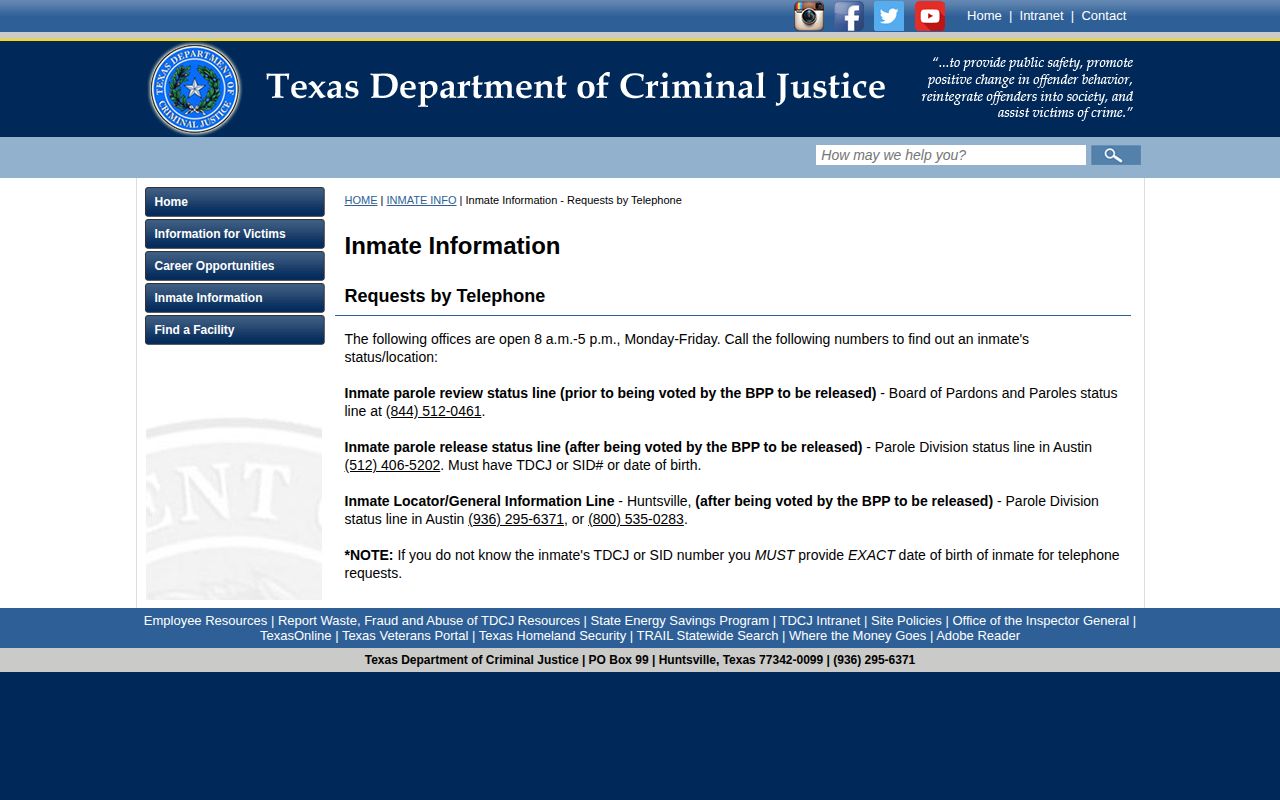
The displayed contact paths help prevent a common mistake: a vote can be complete while the person remains inside a unit pending the next required step.
BPP's main number is 512-406-5452. The review-status line is the better route for the stage before a final vote, while the post-approval number addresses processing after a favorable decision. If a result shows a next-review date, preserve that date and the denial code. If it shows a program-conditioned approval, identify the condition rather than predicting a gate date. New information or unmet requirements can affect the path after the panel vote.
Fannin Parole Has No Hearing Calendar
Texas does not use an ordinary public hearing calendar for parole consideration. BPP's official guidance says formal hearings are not held for parole or mandatory-release review. Members study and vote the file individually. This is a Texas process rule, not a missing Fannin County calendar. The useful substitutes are the person's TDCJ review status, the review-status phone line, and any next-review date after denial.
Ordinary users are not automatically told when review begins. Authorized victims registered through Victim Services have separate notice rights. For public verification, identify the individual, check the current status, and read the matching vote code. A future review date is not a release date. A panel approval is not proof the prison gate process has ended. The post-approval line and later TDCJ release record are the sound sources for that fact.
Fannin Releasees and Reentry Documents
TDCJ's Reentry and Integration Division provides a state-level path for eligible releasees who need core documents. Phase I may help with a replacement Social Security card, certified birth certificate, and state identification. Later phases focus on assessment, planning, and individual case management. These services do not prove parole status, but they can help a person meet practical needs tied to reporting and return to the community.
The TDCJ reentry program is the official starting point. TCOOMMI also conducts pre-release assessment and referral for people with special needs leaving correctional settings, including local jails. Eligibility and the correct route depend on the person's setting and needs. Family members should not assume that a Fannin County jail release and a Cole or Choice Moore release enter the same service track.
How Fannin County Supervision Ends
Supervision ends through a formal agency or court action, not merely because the person no longer appears in a quick search. For local probation, obtain the court or probation discharge record. For parole or mandatory supervision, obtain the TDCJ record that identifies discharge or the end of supervision. A transfer between offices changes who supervises the case but does not end it. A return to custody likewise changes status without erasing the underlying term.
Keep the final document with the person's identifiers and effective date. Texas good-conduct time affects eligibility for parole or mandatory supervision under Government Code Chapter 498, but it does not by itself reduce the judicial sentence. Chapter 508 controls parole and mandatory-supervision eligibility. Those rules explain when review may occur; they are not a substitute for a dated discharge record. When an online result, phone answer, and court document conflict, compare the agency, event date, and whether each source describes a projected, approved, transferred, or completed event.